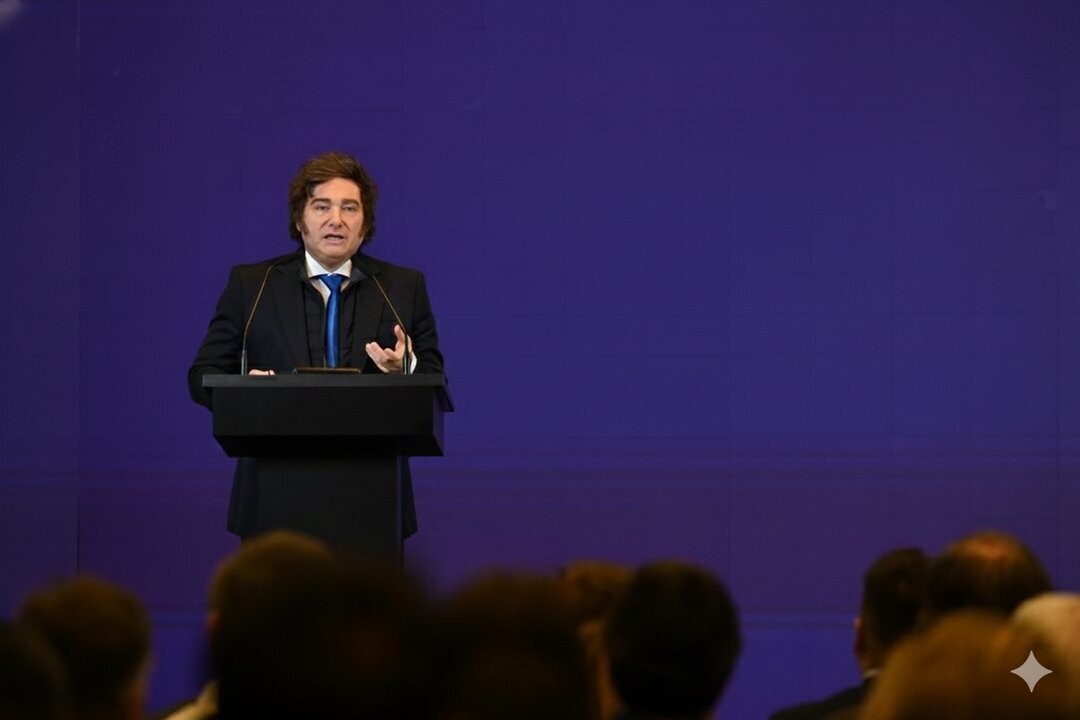
Our monetary rule is zero issuance. What is the problem in Argentina? The expectations. There, the Head of State explained the measures his government will take in 2026 with a Congress favorable to reforms. Words from President Milei: "I want to address today one of the most poorly debated issues in the Argentine economy: that of the real exchange rate. For the Argentine to get up and the exchange rate not to be just anything. Setting aside fiscal balance seems to me to be setting aside precisely the element that explains 20 of the 22 crises Argentina has had since 1900. To be able to say whether the real exchange rate is high or low, one would have to know its equilibrium value. Argentines form their expectations by looking at the dollar, not the amount of money. Argentines, and rightly so, do not form them according to a rational expectations model. The exchange rate is just another price: the price of the dollar. Insurance is for protection, and they would be telling me that I have to insure myself against a crisis by generating a crisis. If with 15% of the deputies and 10% of the senators we made the largest structural reform in Argentine history, with this Congress we are going to go all the way to make Argentina the freest country in the world, that allows us to be great again. That option of generating inflation and ruining the quality of life for millions of Argentines is not mine. A new political horizon We have left behind the adverse political risk. In the Senate, out of 22 seats, we won 13. We are facing the possibility of having the most reformist Congress in Argentine history. We have a balanced budget, a current account deficit generated by private investment, not by a fiscal deficit. Therefore, any assessment of the real exchange rate is precarious. Why we chose the exchange rate bands scheme Inflation is always and at all times a monetary phenomenon caused by an excess supply of money. If I go out to buy dollars by issuing money, I generate an excess supply of money, which causes inflation: a tax on the poor. It took us a lot of work for 13 million Argentines to get out of poverty. This makes sense: for 90 years they were scammed by the Central Bank, which was dedicated to financing politicians who ran fiscal deficits. If I have this mechanism for forming expectations based on the exchange rate and not on the amount of money, the volatility in the foreign exchange market spills over into the goods market. Because we believe in freedom, the bands open up over time; at some point they will be so open that it will be a free exchange rate. The lag of monetary policy, according to recent studies from the University of Córdoba, is 26 months. If the price level goes above the one determined by the amount of money, I generate a recession: a fall in GDP, employment, real wages, an increase in the poor and destitute. The bands are there to put a limit on volatility. The talk has three axes: why many economists are part of the problem and not the solution; why we chose an exchange rate bands scheme; and the issue of reserve accumulation. The problem of the real exchange rate analysis When analyzing the real exchange rate by only looking at the price index, the analysis is intellectually precarious. It is quite arbitrary to choose an index to say there is a problem with the exchange rate when there are IMF and other body estimates that calculate GDP at purchasing power parity, and the difference between GDP at PPP and GDP at current values indicates whether the economy is truly overvalued or not. Furthermore, there is another problem: a macroeconomic issue is looked at with a partial equilibrium analysis, ignoring all other economic situations. I find it pertinent to discuss this controversial topic among economists, analysts, and the general public. The central issue has to do with the rollover: if I have a rollover, I pay the interest with fiscal balance and I roll the debt over in the market. Why do countries that are not the United States or Europe accumulate reserves? Because occasionally the capital market closes. For example, when they make the comparison with 2017, I ask: what part coincides with 2017? Because basically the fiscal adjustment was never made. During the Macri government, 60,000 million dollars in net debt were taken on. Argentine News Agency. We, after 123 years, put in the Treasury's box in a single month and in 6 months the Central Bank. What needs to be bought is an insurance. The election of October 26 was truly impressive. If it had been a presidential election, the result would have been 41 to 24: first round. We won 64 of the 127 seats at stake in the Chamber of Deputies, more than 50% of the available ones. Buenos Aires, Dec 4 (NA) -- President Javier Milei gave a speech at the leaders' meeting at La Rural, an event organized by El Cronista Comercial. The bands fulfill that function: while the dollar is within the bands, the restriction is not effective. The issue of reserves The whole debate about reserve accumulation is not posed correctly. If I had a fully flexible exchange rate, by definition, the variation in reserves is zero. Asking for a flexible exchange rate and asking to accumulate reserves is a contradiction in terms. When there is a zero deficit, the variation in debt is zero. But let's see what premium we are willing to accept. Theorists solve this by creating an artificial bound that allows the model to be solved. Generating poor people to ensure dollars for someone does not seem fair to me. And to know it in general equilibrium, one must know the agents' preferences, the technology, the initial endowments, property rights, and institutions. As Hayek said about the fatal arrogance: there is no way they can know that vector such that they can solve the system. We made an adjustment of 15 points of GDP. If the variation in debt is zero and the gross product expands, automatically the debt-to-GDP ratio falls. But you cannot expect to beat Ben Johnson if you are just learning to crawl. The technical argument behind the bands comes from general equilibrium theory: for the existence of equilibrium, the set must be convex and bounded. In growing economies, the set can be infinite.